Our philosophy of education is three-pronged. The University Model is our structure of education. The Classical Method is our approach to education. The End Student describes our ultimate goal for our students.
University-Model® Schooling
University-Model® Schooling (UMS) was developed as a result of two guiding concerns: to offer students the opportunity to acquire a high degree of academic achievement and to preserve and strengthen the God-ordained family relationships in which the Christian faith is most effectively fostered. The structure in which these two concerns are brought together, University-Model® Schooling, provides an academically challenging education while integrating the home and school in the common goal of discipling children.
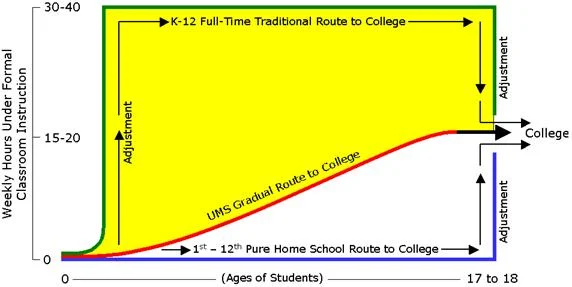
Represented along the left side of this diagram are the different number of weekly hours students would encounter in a classroom setting guided by a professional teacher. Represented along the bottom, from left to right, are the ages of students up to 18, the typical age for high school graduation. The academic benefit of gradually preparing students for direct entrance into college vs. an approach that requires significant adjustments is evident.
Represented along the left side of this diagram are the different number of weekly hours students would encounter in a classroom setting guided by a professional teacher. Represented along the bottom, from left to right, are the ages of students up to 18, the typical age for high school graduation. The academic benefit of gradually preparing students for direct entrance into college vs. an approach that requires significant adjustments is evident.
More importantly, however, is the UMS goal of helping to preserve and strengthen the God-ordained family relationships in which the Christian faith is most effectively fostered. According to information gathered by well-known pollster George Barna, the most critical period when 94% of all boys and girls come to a saving faith in Christ is before the age of 18; 90% before the age of 14! Only 6% will make that soul-saving decision between the age of 18 and their death. Since parents are the most influential factor in this decision, it is vital that models of education exist that recognize the significance of keeping parents involved with their children during the early, critical years of a child’s education. Represented by the shaded portion of this diagram is an indication of the additional amount of time the UMS model, in contrast to the traditional model, strives to preserve for the influence of parents. Unfortunately, if there is a breakdown in the preservation of parental influence during a child’s educational years, then it will likely be measured in lost souls.
The key to success for the UMS model is the integration of a biblically based, parentally guided, Christian faith and a sound, teacher-facilitated, academic environment. The Bible gives parents authority and responsibility for raising their children with the goal of becoming disciples of Jesus Christ. In matters of education, that parental authority and responsibility, although not surrendered, may be shared with an educational institution when the parents consider it desirable or necessary. In such cases, a University-Model® School will assist, and not supplant, parents in their work of training and educating their children.
Parents will retain the oversight of their children’s educational progress and will determine the manner and extent to which they will be involved in the academic institution. Parents will help place each child in the proper stage of academic progress. Parents will also be involved in the out-of-class instructional responsibilities of their children’s courses based upon each child’s age and stage of academic development. In addition, parents will continue to build into their children those character qualities that reflect their own understanding of the Christian faith.
The University-Model® School, on the other hand, will operate under the umbrella of parental authority by offering a challenging academic track in the context of Christian values. The school will unapologetically speak and teach in a manner consistent with the school’s statement of faith, emphasizing the necessity of a personal relationship with Christ and growth in Christ-like character. The school will also help parents properly place each of their children in an appropriate stage of academic development. In addition, the school will develop and implement academically challenging, college-preparatory courses that integrate an appropriate level of parental involvement into each student’s out-of-class study. The school will encourage and expect the student to learn the material assigned and will provide regular feedback to both the student and parents concerning the student’s progress in each class enrolled. Finally, the school will integrate the Christian faith and a biblical worldview into the context of the various subject areas offered, to the end that Christian character-building will receive support and enhancement outside the home.
University-Model® Schooling is designed for those families in which parents take an active role in the oversight and implementation of their children’s education. As the level of parental involvement progresses from being a private tutor in the elementary years to a guide for dependent study in Junior High to more of a course monitor in the Senior High courses, parents are expected to continue exercising loving and active responsibility for their children all the way through graduation. In partnership with these committed parents, the school is then able to integrate the home and school effectively toward the common goal of Christian character development and solid academic preparation for college.
Classical Education
Classical education is a return to “the point at which education began to lose sight of its true object” (Douglas Wilson, Repairing the Ruins); equipping young people with the tools to learn and think. It is firmly rooted in the traditions of Western culture, and draws upon educational methods which were employed at a time when Christ and Christianity were the center and foundation of all learning.
More than promoting a particular brand of curriculum, or mastery of a particular set of subjects, classical educators seek to cultivate a mindset. This mindset is marked by a belief that Christ is the wellspring of all wisdom and knowledge. It is humble, demonstrating a profound willingness to learn from the past. Cultivators of the classical mind argue that “We must understand the world in the light of Christ” and that “He is the light in which we see truth.”
Recognizing that education is never ‘values neutral,’ classical educators seek to transmit Christian values by “presenting all subjects as part of an integrated whole with the Scriptures at the center” (Douglas Wilson, Repairing the Ruins). One of the primary methods to accomplishing this goal is the Trivium, a Medieval educational method which consists of three parts: Grammar, Dialectic, and Rhetoric. Each part corresponds to the three main stages of childhood development.
Grammar phase (grades K-6)
This phase emphasizes the accumulation of basic facts and memorization. Each subject has its own “grammar.” The grammar of history, for example, consists of dates, events, and personalities and it is items such as these which students are encouraged to commit to memory.
Dialectic phase (grades 7-8)
This phase involves the study of logic and argumentation. Children are known to be naturally argumentative at this age, and the Dialectical approach seeks to capitalize on this tendency by teaching them the proper ways to argue. Students are taught to examine what they are taught and think it through, understanding that “it is good to question (provided the questioning is intellectually rigorous and honest);” however, the emphasis is not questioning for its own sake, but questioning in order to “find and close upon the truth.”
Rhetoric phase (grades 9-12)
This phase emphasizes “clear-minded expression.” It presupposes that, by the age of 14, the average student’s thoughts have synthesized and that he or she has developed a point of view. The task now is teaching him or her how to express it logically, persuasively, and eloquently.
Ultimately, classical education is oriented toward re-instating the belief that “God is the Light in which we see and understand everything”. It is within this tradition that we, at Veritas Academy of Tucson, seek to follow.
End Student
What do we want a graduate of Veritas to be like? That question is where our curriculum planning begins, at the end. The End Student is what we call our vision for our graduates. Everything is planned backwards from that picture.
A big part of our End-student vision comes from Stephen in Acts chapter 6: “And Stephen, full of grace and power, was doing great wonders and signs among the people. Then some of those who belonged to the synagogue of the Freedmen (as it was called), and of the Cyrenians, and of the Alexandrians, and of those from Cilicia and Asia, rose up and disputed with Stephen. But they could not withstand the wisdom and the Spirit with which he was speaking.”
Notice three important words from that last sentence: wisdom, Spirit and speaking.
Wisdom and Speaking
In the book of Proverbs, you’ll find wisdom grouped with knowledge and understanding:
My son, if you receive my words
and treasure up my commandments with you,
making your ear attentive to wisdom
and inclining your heart to understanding;
yes, if you call out for insight
and raise your voice for understanding,
if you seek it like silver
and search for it as for hidden treasures,
then you will understand the fear of the LORD
and find the knowledge of God.
For the LORD gives wisdom;
from his mouth come knowledge and understanding;
Proverbs 2:1-6 ESV
You can see a progression. Knowledge leads to understanding which leads to wisdom. In many ways, that’s the biblical version of the Classical trivium of grammar, logic and rhetoric. Wisdom is the goal in the passage above. In Classical education, everything builds up to rhetoric. Wisdom and rhetoric (the art of speaking wisdom) go hand in hand. The wisdom that came from Stephen’s Hellenistic Jewish upbringing and the way he was instructed in rhetoric were a dynamic duo.
The Spirit
But read that passage again with different words emphasized:
My son, if you receive my words
and treasure up my commandments with you,
making your ear attentive to wisdom
and inclining your heart to understanding;
yes, if you call out for insight
and raise your voice for understanding,
if you seek it like silver
and search for it as for hidden treasures,
then you will understand the fear of the LORD
and find the knowledge of God.
For the LORD gives wisdom;
from his mouth come knowledge and understanding;
Proverbs 2:1-6 ESV
There isn’t a formula that can be followed to get the knowledge, understanding and wisdom of God. It is a gift from the Lord. Stephen was a great speaker, but he had something the others didn’t: the Spirit. The wisdom of the gospel is only from the Spirit. We see in Proverbs 2 that this wisdom is to be treasured up and sought like silver and hidden treasure. This isn’t simply a formula: put knowledge in and get wisdom out!
In Desiring the Kingdom, James K.A. Smith points out that “Being a disciple of Jesus is not primarily a matter of getting the right ideas and doctrines and beliefs into your head in order to guarantee proper behavior; rather, it’s a matter of being the kind of person who loves rightly.” Education (and raising children in general) is not primarily an informative task, but a formative one. The End Student isn’t someone who simply knows the truth, but he loves it like a hidden treasure he’s sought his entire life. That sort of love comes from the Spirit, through daily God-given bodily habits of grace: reading scripture, prayer, being in fellowship centered around the Lord’s table with God’s people. The key to discipling students in this way is to develop for them a beautiful picture of Christ’s kingdom. Antoine de Saint-Exupéry wrote, “If you want to build a ship, don’t drum up the men to gather wood, divide the work, and give orders. Instead, teach them to yearn for the vast and endless sea.” Casting our vision (the ends) for our End Student is also, then, the means for achieving it in the student’s lives.
The University-Model, in that it gives more time for the students to be at home during the week, has a leg up on other schools, as it is the parents that God has specially equipped and commanded to raise their children in the nurture and admonition of the Lord (Ephesians 6:4).